


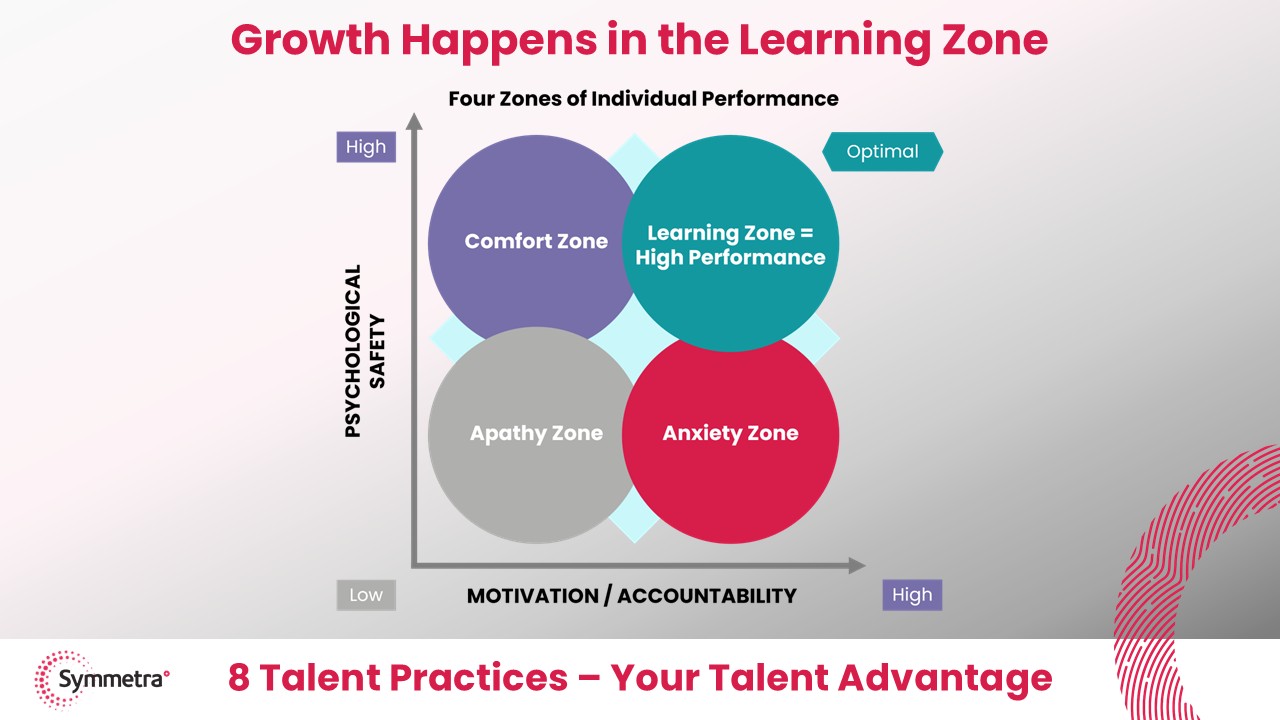
Strategic talent development is on many companies’ radars, yet organizations still hesitate to move high-potential talent into stretch roles until someone is “ready.” But readiness isn’t a destination—it’s a path. Real growth happens not in the comfort zone or the anxiety zone, but in the learning zone, where challenge meets support.
Building on Amy Edmondson’s work on psychological safety and accountability (The Fearless Organization), psychological safety—the belief you can ask questions, admit mistakes, and offer dissent without fear—doesn’t lower the bar. It enables accountable performance and accelerates development. When safety and standards are high, leaders grow in the learning zone rather than the anxiety zone, where pressure to prove oneself inhibits learning and undermines leadership growth.
Too often, stretch roles become “sink or swim” tests. Leaders are offered a new assignment with an implicit message: this is your big break. It’s positioned as development, but in reality, it’s a high-risk readiness check. Growth accelerates when we design stretch assignments that clarify outcomes, define success measures, build feedback loops, and make it explicit that the career sponsor and line manager have their back.
A timely example on most global talent agenda’s is international assignments, where stakes are high. Moving a high-potential leader into a new country and culture can be a powerful accelerator: global context broadens judgment, cross-cultural collaboration deepens empathy, and market complexity builds strategic agility. Many return with sharper perspective, stronger stakeholder skills, and readiness for bigger enterprise roles.
But without the right conditions, the same assignment can tip from learning to anxiety: unfamiliar norms, new stakeholder maps, and external dynamics can make asking for support feel risky—like signalling you’re not up to the role. The difference is profound. When we engineer the learning zone for assignees, success becomes intentional. It starts with explicit sponsorship—a senior sponsor who stays close, legitimizes questions, and helps decode the local culture and ecosystem. It relies on managerial scaffolding—clear outcomes, early wins, regular coaching touchpoints, and fast feedback that normalizes adjustment as part of the job. These considerations hold the tension of keeping leaders in the learning zone—not the anxiety zone.
So, when stakeholders or the board ask how to build high-potential talent for executive succession, make this a critical, often overlooked success factor in your talent strategy. Don’t wait for readiness. Design it. If you’re moving high-potential leaders—especially across borders—make the learning zone intentional: clear outcomes, visible sponsorship, cultural decoding, and feedback that turns experience into capability. The question isn’t whether stretch assignments build talent; it’s whether we’ve engineered the conditions so that growth delivers high performance and longevity for senior roles.